Monday, December 10, 2018

The Story of One

It is sometimes surprising where you read information that confirms and supports your beliefs and ultimately your actions. Recently I have been listening to the book The Hole in Our Gospel by Richard Stearns. In it he shares the following research:

In 2006 researcher Paul Slovic at the University of Oregon and colleagues Deborah Small of the Wharton School and George Lowenstein of Carnegie Mellon University performed a simple behavioral experiment. A test group of ordinary people was divided into three subgroups. The first read the story and saw a photo of a poor, starving seven-year-old African girl name Rokia. The second group was given a statistical portrait of seventeen million Africans in four countries who were desperately hungry because of crop failures and food shortages. They were told about yet another four million who were homeless. In other words, group two read about hunger and suffering on a massive scale. The third group was given the story about the little girl Rokia but was also given the statistical information given to group two. Finally participants in all three groups were asked to donate money to relive the suffering. Amazingly, the group that heard only Rokia's story gave the most money. The group that was given the statistics about twenty-one million suffering people gave the least, and the group that received both pieces of information was only slightly more generous than the statistics-only group. The story of one child was more compelling than the suffering of millions.

The story of ONE child... 

Now I don't want to take away from what Stearns was communicating here because what he shares is so important when it comes to helping others in our world. But I couldn't help but relate it to what we do in education. 

As educators we are constantly looking at data. We love our numbers. In Georgia the ultimate number looked at is CCRPI (College and Career Readiness Performance Index). I won't go into great detail about what that number means (most states have some method of grading their schools), but basically it is a grade that comes about by looking at end of year test scores and other factors. So, it is a number that evolves from other numbers. This number is used to label and group students, schools, and school systems. Somewhere in all of those numbers is the story of ONE child. 

Do you see the disturbing significance of the research shared above and how it connects to our current reality? Ever since NCLB more and more focus has been placed on test scores, grading schools and labeling schools and students. Because of this we have taken our focus off the very purpose we went into education to begin with, which is to improve the lives of children. 

Brad Gustafson, is a voice shouting in the wilderness that it is time to reclaim our calling. What he says in his book Reclaiming Our Calling completely lines up with the research I presented above. He says, "If you're anything like me, you're growing weary of watching assessment data used primarily to label and group learners." Yes! I agree, Brad. It's just like those people who were given only the statistics of suffering people. By being given the statistics about suffering people in Africa they inadvertently dehumanized the very people that needed their help the most. Stearns said, "If we are able to objectify whole classes of people so that we don't think of them as persons equal with us, the unthinkable becomes possible."

Our students deserve more. They are more than a number. I daresay it is time to shift our mindsets from numbers to individual students. I know that seems a little scary because in essence we are going against the flow, but it is time. It is time to look at Johnny and David and Beth and Lisa and Luke. Who are they? What do they need? How can we help them grow? This change will not happen overnight but if we will just take small steps we will begin to see the benefits. 

One small step we have taken at the school where I am a principal is using our PLC time to discuss individual students. We have "data cards" for every student in our building. These data cards have their picture along with their data. We can't ignore the data and the fact that we are held accountable, we just have to keep our priorities in the right place. This one small action is yielding a lot of dividends in how we view our students and the plans we make for each one of them. 
It is time to know and value ...the story of ONE child.


Tuesday, August 21, 2018

Going All In: Conquering Our Fears of Unknown

Going All In: Conquering our Fears of the Unknown
A couple of weeks ago my niece and nephew came to visit from Newnan. They wanted to swim in our pool one last time before we officially sold our house and moved out. They swim like fish because they have always been around pools. However, they have never jumped off the diving board into the deep end. In fact, they have never swum in the deep end at all.

Uncle Andy is notorious for challenging kids to do things that are outside of their comfort zone. So, he challenged them to jump off the diving board. Needless to say, they were scared and kept saying they couldn’t do it. Uncle Andy kept begging them to (and eventually promised them Sweet Frog if they would do it).

Emmalyn was the first to try. She stood on the diving board for an extended period of time. She would walk to the edge of the diving board and then back up. She did this several times. Then all of a sudden she mustered up every ounce of courage and....
...she jumped. She went ALL IN. Because of her courage Ethan (her twin) gained the courage to jump in himself.

What happened next was amazing. They just wanted to jump in over and over and over. Their fears was gone. They weren't even thinking about the initial bribery of Sweet Frog that was used to get them to jump in the first time. They realized that their fear was unfounded, that jumping ALL IN could be fun and it was not unknown to them anymore.

It just took ONE time. And even though Ethan was scared to begin with, when he saw his sister jump in, her COURAGE motivated him to be BRAVE.

Lesson from this: At Alto Park Elementary School we are going ALL IN for our students this year. We are not going to do the same 'ol same 'ol things we have done in the past. We are not going to stay in the shallow end because it is comfortable. Why? Because our students (each and every ONE of them) deserve more. Some of us are going to be asked to do things that we have never done before in order to reach that ONE student. Some of us are going to be innovative and think outside the box. You may be scared to step out and do something new, but just do it.
JUMP OFF!   GO ALL IN!
I can't bribe you with Sweet Frog, but I can promise you that if you go ALL IN the reward will be well worth the effort and better than Sweet Frog any day (nothing against frozen yogurt). 

And if you see one of your colleagues scared to try something new, then you lend them your courage. Your courage motivates someone else and someone else's courage motivates you. 

...let us think of ways to motivate one another to acts of love and good work. Hebrews 10:24


Tuesday, June 26, 2018

I Needed a Champion


Rita Pierson is best known for her TED talk in which she says, "Every child needs a champion." Let me repeat that:
Every child needs a champion. 

I am currently reading Culturize by Jimmy Casas (@casas_jimmy). In his book Jimmy echoes Rita Pierson's words in his Core Principle #1: Champion for Students.

As I was reading, the following quote jumped off the page and became so real to me:


When I read it I instantly thought of Mrs. Dunn. She taught the Teacher Academy class my senior year of high school. This was the first year this class was offered. We had to go through an interview process to determine if we would be selected. I must go ahead and tell you that I believe in providence. I was selected for this class because God knew I needed a champion my senior year in high school.

Senior year of high school was a difficult year. Without going into personal details I will say that before the year was half way over I was considered to be an emancipated minor (someone under the age of 18 who is no longer considered to be under the control of their parents; they take responsibility for their own care).

Enter my champion, Mrs. Dunn. Now if you were to ask Mrs. Dunn today if she considered herself to be a champion, she would humbly say that she was doing what she felt was right for her students...that she was just doing her job.

To this scared 17 year-old, she was doing so much more than that. Her encouragement and support were integral in keeping me in school and on the right path at a time when I was lost and alone and could have easily slipped off the radar.

This past May I was in the TJ Maxx dressing room while my daughter was trying on clothes. An idea fired across my synapses as I was reflecting on the upcoming Teacher Appreciation Week I was about to celebrate with my new staff: I need to tell Mrs. Dunn that what she did for me 25 years ago truly mattered.

I pulled out my phone and searched for her on Facebook. Once I found her I sent her this message in Messenger:
I hit send. And I waited. Then finally I saw those three dots...you know the ones I am talking about...the ones that tell you the person has seen your message and is responding. 

What I got back brought tears to my eyes and confirmed that I did a grand thing by sending my message. 

When I didn't believe in me, she did. She was right. If someone had told me in high school that I would be a principal one day I would have laughed. Me, a principal? No way! She saw something in me that I didn't see in myself and pushed me through to the finish line. 

Educators, hear me out...
What we say and do for our students has a lasting impact. The words you speak over them and the belief you have in them may just be the thing they need to keep them from slipping into darkness. Yes, we have that kind of power. Every single day that you walk into your school please know that you have the power to be a child's champion. And...

Every child needs a champion. 


Wednesday, September 13, 2017

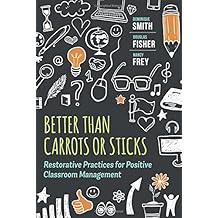
Better Than Carrots or Sticks: A Slow Twitter Chat Bookstudy

I am an Assistant Principal at an elementary school which means one of my many responsibilities is discipline. After 6 years of pretty much following the same procedure (discipline referral leads to consequence such as time out, detention, ISS (In School Suspension) or OSS (Out of School Suspension), I began to feel an unrest and knew that we could not continue to do what we have always done because we would continue to get what we always got. What we have gotten every year is an increasing number of ISS and OSS days. Neither of which options were making an impact in the lives of our students as most of them were going on to the middle and high school receiving the same consequences because there was no behavior change. I am not satisfied with the status quo.
Product Details
Then one morning while at Starbucks I participated in the #LeadLAP twitter chat when the words "Restorative Practices/Discipline" caught my eye and caused many thoughts to start firing through my synapses.

What is Restorative Practices?
The restorative approach to discipline incorporates principles of the SWPBIS approach to focus on prevention through relationship building by drawing on the collective strengths of the community to help individuals in trouble regain their footing in a nurturing environment with consistent classroom practices and high expectations. Most of all, restorative practices draw their strength from communication tools: adults use language that builds agency and identity and facilitate class discussion in a way that encourages affiliation and resolves problems. Restorative practices represent a positive step forward in helping all students learn to resolve disagreements, take ownership of their behavior, and engage in acts of empathy and forgiveness (Better Than Carrots or Sticks: Restorative Practices for Positive Classroom Management, Smith, Fisher, Frey). 

As I have decided to take the plunge this year I would like to learn from other experts around the world. Twitter is an amazing place in which to do this. So, I am going to facilitate a bookstudy on Better Than Carrots and Sticks: Restorative Practices for Positive Classroom Management, by Dominique Smith, Douglas Fisher, and Nancy Frey. You can pick up your copy at amazon.com.

I will post the discussion questions on Twitter using the usual Q1, Q2, Q3 format. Participants will respond to the questions using the A1, A2, A3 format. I will post one question per day, Monday-Friday. This will hopefully give you plenty of time to read and thoughtfully respond to the questions as well as to others' posts. (Thanks to Mr. Hills' blog for providing me with a format).

I have created a hashtag for our bookstudy. Please use it when discussing anything related to the book.

#btcsbookstudy


Here is the schedule:
October 2-6, 2017 Chapter 1
October 9-13 Chapter 2
October 16-20 Chapter 3
October 23-27 Chapter 4
October 30-November 3 Chapter 5
November 6-10 Chapter 6
November 13-17 Wrap up discussions

I am just beginning to learn about Restorative Practices and how it can impact the students in my building. I am hopeful that if we can begin implementing some of the practices we can teach our students to "learn to resolve disagreements, take ownership of their behavior, and engage in acts of empathy and forgiveness."

Wednesday, August 23, 2017

Our Debt to the this Generation

What am I doing to make a difference?

I am troubled by all the violence in the world. It is weighing heavy on my heart.

I am sure you have heard about the recent violence in Charlottesville, Virginia (unless you live under a rock). Charlottesville is not an isolated incident; it is one of many that we have witnessed just this year alone. It almost seems that you can't turn on the news without hearing about violence occurring somewhere in our nation. I have found myself wanting to boycott the news, not watch it anymore, as if that is the solution to the problems our nation is facing. While that is sometimes what I feel like doing I know it will not solve anything.

What will? How do we begin to move away from all of this violence? Is it even possible anymore or has it gone too far? Can one person make a difference?

YES! One person can make a difference. As educators we can make a tremendous difference in the lives of the students we are charged with educating.

There are so many things we can do to impact the lives of children, no matter their age. Two ideas to embrace:
1. As adults we must cultivate a growth mindset. We have to stop saying, "This is how it was done in my day and it worked for me." In case you haven't noticed this generation is different, we can't make them who we were. Be open to who they are.

2. It is our job to serve this generation. We all came into this world owing everything to everybody. When we die we should leave this world in such a way that they are indebted to us. A.W. Tozer said: "You cannot serve the last generation, because it is gone. In addition, you can only indirectly serve the next generation, but you can serve this present generation."

Embracing these two ideas (among others) can create a synergy that can be the catalyst to the change needed to grow a generation of kids ready to make a positive difference in the world.
Image result for kids

I want to make a difference. I want to serve this generation.

I am an Assistant Principal at an elementary school which means one of my many responsibilities is discipline. After 6 years of pretty much following the same procedure (discipline referral leads to consequence such as time out, detention, ISS (In School Suspension) or OSS (Out of School Suspension), I began to feel an unrest and knew that we could not continue to do what we have always done because we would continue to get what we always got. What we have gotten every year is an increasing number of ISS and OSS days. Neither of which options were making an impact in the lives of our students as most of them were going on to the middle and high school receiving the same consequences because there was no behavior change. I am not satisfied with the status quo.

Then one morning while at Starbucks I participated in the #LeadLAP twitter chat when the words "Restorative Practices/Discipline" caught my eye and caused many thoughts to start firing through my synapses.

What is Restorative Practices?
The restorative approach to discipline incorporates principles of the SWPBIS approach to focus on prevention through relationship building by drawing on the collective strengths of the community to help individuals in trouble regain their footing in a nurturing environment with consistent classroom practices and high expectations. Most of all, restorative practices draw their strength from communication tools: adults use language that builds agency and identity and facilitate class discussion in a way that encourages affiliation and resolves problems. Restorative practices represent a positive step forward in helping all students learn to resolve disagreements, take ownership of their behavior, and engage in acts of empathy and forgiveness (Better Than Carrots or Sticks: Restorative Practices for Positive Classroom Management, Smith, Fisher, Frey). 

I am just beginning to learn about Restorative Practices and how it can impact the students in my building. I am hopeful that if we can begin implementing some of the practices we can teach our students to "learn to resolve disagreements, take ownership of their behavior, and engage in acts of empathy and forgiveness."

Is it grasping at straws to think this could help this generation handle conflict in a peaceful way so that we have fewer incidences like what happened in Charlottesville, Va? Don't we owe it to this generation to try?

Wednesday, July 5, 2017

It's a Journey Part 2: The First Idea to Put in Our Mind-case

IT'S A JOURNEY
In this journey the first idea that we need to pack in our mind-case is the idea that ALL really does mean ALL.


Go to dictionary.com if you wonder what the definition of "all" really is and this is what you will find:


So, now that you have a firm understanding of what ALL means take just a moment to check your mission statement. Go ahead...leave this blog for just a moment (just make sure you come back) and check your mission statement. I will wait...

So, did you see words in your mission statement like:

ALL       EVERY     COMPLETE      ENTIRE

I am not saying that we should take these words out, but that we need to align our actions with the words we put in our mission statements. According to Mike Mattos, our mission statement is our "northstar." He shares the following ideas about our mission statement: 
  • states our organizations fundamental purpose
  • guides our decisions and actions
  • provides a path, framework, and context for which strategies are formulated
  • illustrates what the organization wants to do for the world. 
So, look at your mission statement again and imagine having a conversation with other educators in your organization about the specific words they chose to be a part of the statement. Imagine asking them this question: 
Chances are you will hear some variation of the following answer: 
"YES, BUT...

Have you heard any of these answers? Have you expressed any of these answers? I know I have at some point in time. If so, let me suggest that the first idea that must go into your mind-case is that "all means all." We have to stop making excuses. If all really means all, then we have to do whatever it takes to ensure that ALL students learn at high levels. This will undoubtedly be a paradigm shift for many of us. But remember that the ideas we allow into our mind-case have the potential to change our attitudes which will cause us to behave and react in a certain way. 

Believing that ALL means ALL will allow us to see our students as they can be, not as they are now.

Mike Mattos shared in his keynote at the PLC Work Institute in Atlanta, "If we collectively commit to each other and publicly profess that our mission is to ensure that all students learn at high levels, then don't we have an obligation to align our actions to this outcome?" I don't know of any true educator who would not answer that question with a resounding, "YES!" 

This work is not going to be easy; but nothing worth doing well is easy. It is going to take a mindset change and when the work gets too hard, remember your why. My good friend Teri Pendley stressed the importance of knowing your "why" in her blog, "My First Blog Post-Why?"

Remember, becoming a PLC is a journey, not a destination. Let's make sure we are packing the right ideas into our mind-case, roll up our sleeves and get ready for a wild ride. Our students deserve it. 

(Click here to read It's a Journey Part 1: Our Mind-Case


Monday, July 3, 2017

It is a Journey Part 1: Our Mind-Case

IT IS A JOURNEY

I had the privilege of attending the PLC at Work Institute in Atlanta, Georgia this week. Before attending this conference I thought I had a good idea of what a Professional Learning Community was; however, while some of what I knew was confirmed, much of what I learned was new information.

The biggest AHA* I had throughout the 2 1/2 days is that implementing a PLC is a journey, not a destination. What is the difference? Well, a destination has an end point in mind. You know where you are going, and you know when you have arrived. There is a definite beginning and ending. A journey is not the same.

Dictionary.com defines journey as: "passage or progress from one stage to another." If we are to have PLCs that work, we have to envision our work as journey. We will always be progressing from one stage to another. We will never "arrive."

So, understanding that we are on a journey and not just setting out for a destination, let's be intentional about the ideas and concepts we allow to become a part of our mindset. This is essential if we are going to successfully implement a PLC in the way it is truly intended to be implemented. The ideas we give credence to will be the ideas that shape our understanding and change our thinking. So, just as we are thoughtful about what we pack in our suitcase when going on a journey, we need to be thoughtful and intentional about the ideas we pack into our "mind-case**."
Definition of "mind-case": the place in our brains where we allow ideas/information to enter that has the potential to change our attitudes which will cause us to react and behave in a certain way.

I am devoting the next several blogs to the concepts and ideas I have learned from the experts*** on what a true PLC looks like. Once we begin truly believing what a PLC is and what it takes to create and sustain it, our minds will change and student learning will mean more than ANYTHING else we do.

*I am paraphrasing my definition of AHA from Kyle Idelman. It is a 3-step process and all 3 steps are necessary. There is an Awakening to a new truth or idea. Then there is Honesty in which you evaluate what you already know with the new information you are learning. Finally, there is Action in which you DO something with the new information. 
**Mind-case is a term that I came up with when writing this blog. When I typed the term into dictionary.com to see if it had a definition all that came up was, "Did you mean 'nut-case'," so i think it is safe to take credit for this term. 
***The ideas presented in this blog are an attempt to synthesize what I am packing into my "mind-case" from what I am learning from great minds, such as the DuFours, Tim Brown, Mike Mattos, and others.